Меню

FuseBeads Hub © 2026

Flower Fuse Bead Patterns for Spring: Roses, Tulips, Daisies & Sunflowers

Create beautiful flower fuse bead patterns for spring! Get color guides, step-by-step instructions, and tips for roses, tulips, daisies, and sunflowers.

Начинающий5 min read чтения

Why Flower Fuse Bead Patterns Are Perfect for Spring

Spring is a season of renewal, and there's no better way to capture its vibrant energy than with flower fuse bead patterns. Whether you're a beginner looking for your first project or a seasoned crafter seeking new inspiration, floral designs offer endless possibilities. From delicate daisies to bold sunflowers, these patterns allow you to play with color and shape while creating something truly beautiful. Fuse bead flowers are incredibly versatile. You can turn them into coasters, magnets, keychains, or even wall art. If you're new to the craft, start with our guide for beginners to learn the basics of pegboard placement and ironing. Once you've mastered the fundamentals, you'll find that flower patterns are a fantastic way to experiment with gradients and shading. One of the best things about flower fuse bead patterns is that they work with any bead brand. Whether you use Perler, Hama, or Artkal, the color palette is virtually limitless. For a deeper dive into brand differences, check out our Perler vs Hama vs Artkal comparison. But for now, let's focus on the blooms that define spring.

Essential Materials and Tools for Floral Fuse Bead Projects

Before you start crafting your spring flowers, gather the right supplies. You'll need midi or mini fuse beads in a variety of colors, a square pegboard (or a shaped one for specific designs), ironing paper, and an iron. Tweezers are also helpful for placing small beads precisely. For a complete rundown of recommended tools, see our fuse bead tools guide. Color selection is crucial for realistic flowers. For roses, you'll want deep reds, pinks, and greens for leaves. Tulips call for bright yellows, oranges, and reds with sturdy green stems. Daisies are simple: white petals and a yellow center. Sunflowers need golden yellows, browns, and dark greens. A good fuse bead color guide can help you match shades accurately. Don't forget about storage. Keeping your beads organized by color will save you time and frustration. Our guide to storing fuse beads offers practical solutions, from compartment boxes to labeled jars. Once your workspace is set up, you're ready to create.
Essential Materials and Tools for Floral Fuse Bead Projects

Step-by-Step: Crafting a Classic Rose Pattern

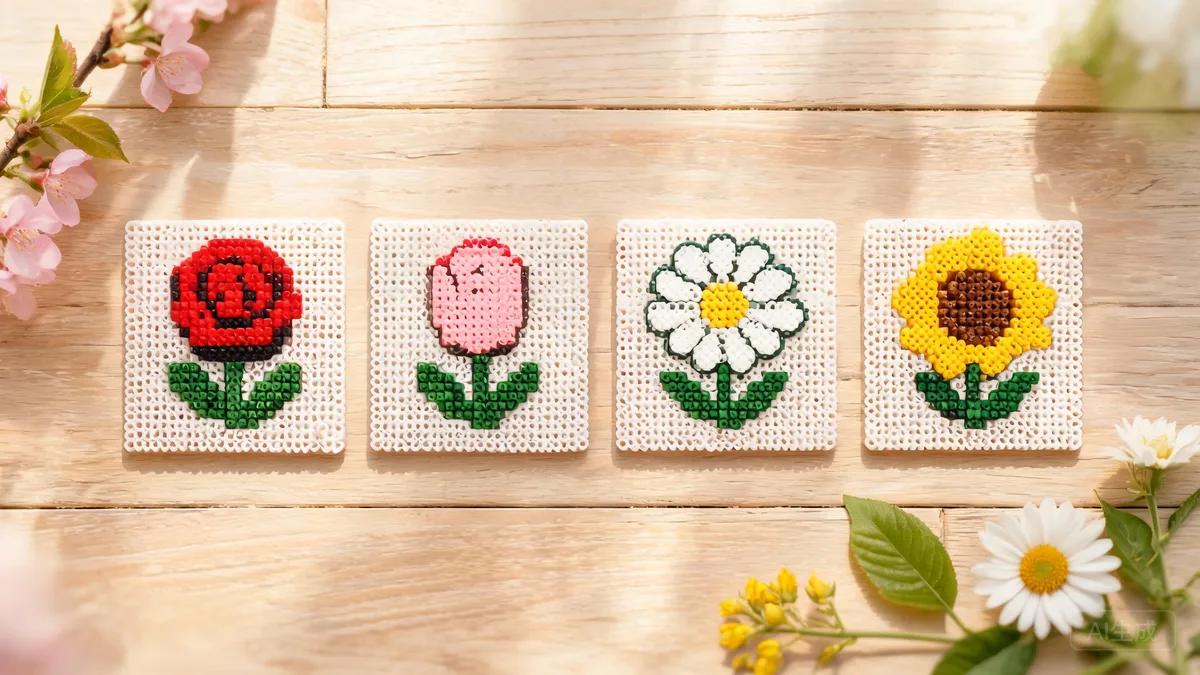
The rose is a timeless symbol of love and beauty, and it translates beautifully into fuse beads. Start with a square pegboard and plan your design. A simple rose can be built in concentric circles: an inner bud of deep red, surrounded by lighter pink petals, with green leaves at the base. Use a pattern template or design your own using our pattern generator for precise placement. Begin by placing the center bead, then work outward in rings. Alternate shades to create depth. For the leaves, use two or three greens to add realism. Once the design is complete, cover it with ironing paper and iron on medium heat in circular motions until the beads fuse. Let it cool completely before removing from the pegboard. For detailed ironing instructions, see our how to iron fuse beads guide. Your finished rose can be turned into a coaster, a magnet, or even a decorative ornament. The possibilities are endless!

Tulips, Daisies, and Sunflowers: Variations and Color Guides

Tulips are a spring staple, and their simple cup shape makes them ideal for fuse beads. Use a rectangular pegboard to create a row of tulips in different colors: red, yellow, orange, and pink. Each tulip consists of a bulbous head and a straight stem with two leaves. For a realistic look, use a darker shade at the base of the petals and a lighter shade at the top. Pair them with a photo frame for a charming spring display. Daisies are the epitome of simplicity and cheer. A classic daisy pattern uses white beads for petals and a yellow center, but you can also try pink or blue petals for variety. Arrange the petals in a radial pattern around the center. These are quick to make and perfect for keychains or earrings. Sunflowers are bold and sunny. Use golden yellow for the petals, a large brown center, and dark green for the stem and leaves. The key is to make the center textured by mixing brown and dark brown beads. Sunflowers look stunning as wall art or as part of a larger garden scene. For more floral inspiration, browse our cool ideas section.
Tulips, Daisies, and Sunflowers: Variations and Color Guides

Tips for Perfecting Your Flower Fuse Bead Patterns

Creating flawless flower patterns takes practice, but a few tips can elevate your results. First, always use a pattern or grid to ensure symmetry, especially for radial flowers like daisies. Second, iron evenly—over-ironing can cause beads to lose their shape, while under-ironing may lead to breakage. Test your iron on a small sample first. Another tip is to experiment with bead finishes. Some brands offer translucent or glitter beads that can add a magical touch to petals. For a more dimensional look, try layering two fused pieces or using a 3D fuse bead technique. Finally, don't be afraid to mix colors creatively. Spring flowers come in countless hues, so let your imagination bloom. If you're crafting with kids, ensure safety by following our fuse beads safety guide. And remember, practice makes perfect—so keep creating!

Displaying and Gifting Your Spring Flower Creations

Once your flower fuse bead patterns are complete, it's time to show them off. Coasters are a practical and pretty choice—they protect surfaces while adding a splash of spring color. Check out our coaster guide for inspiration. For a more permanent display, mount your flowers on a canvas or frame them as wall art. These creations also make thoughtful gifts. A set of floral magnets can brighten up a friend's fridge, while a beaded photo frame with a tulip border is a heartfelt present. Explore more gift ideas to spark your creativity. If you're looking to expand your craft, consider making matching fidget toys or Christmas ornaments with a floral twist. The skills you build with spring flowers will serve you well in any season.

Часто задаваемые вопросы

What colors do I need for a basic flower fuse bead pattern?

For a basic flower, you'll need at least one color for petals (e.g., red, yellow, pink, or white), one for the center (often yellow or brown), and one or two greens for leaves and stems. A good starter palette includes red, yellow, white, light green, and dark green. You can always expand with more shades for realism.

How do I prevent my flower patterns from curling or breaking?

To prevent curling, iron evenly on both sides and place a heavy book on the piece while it cools. Avoid over-ironing, which can make beads flat and brittle. For larger pieces, iron in sections and let cool completely before handling. Using quality beads and following our ironing guide will also help.

Can I use mini beads for flower patterns?

Absolutely! Mini beads (2.6mm) are perfect for intricate flower designs with fine details. They require a mini pegboard and a bit more patience due to their small size. The result is a delicate, detailed piece that looks stunning. Just ensure you have good lighting and tweezers for precise placement.

What can I make with finished flower fuse bead patterns?

The options are endless: coasters, magnets, keychains, earrings, brooches, wall art, photo frames, and more. You can also attach them to greeting cards, decorate notebooks, or turn them into hanging ornaments. Let your creativity guide you—any flat surface can become a canvas for your floral creations.

Готовы создавать собственные схемы?

Открыть бесплатный конструктор
Поделиться: